
Too much Chloe. Not enough me
Why I made an editor designed to push back — and what happened when she did.


If people cannot write well, they cannot think well; and if they cannot think well, others will do their thinking for them.
–George Orwell
Orwell assumed the threat to thinking was allowing other people to do it for you.
Today's threat is more subtle: the tools designed to help you can kill your voice, your thinking and your words — with kindness and flattery engineered to keep you coming back.
Writing is an integral part of how I communicate my ideas, thoughts and work to clients.
I’ve always enjoyed writing, it’s a lifelong graft to craft. As someone who often works remotely, being left to my own devices is not always a good idea when publishing my own words.
I’ve been experimenting with AI for two years now, across various platforms. I created a ChatGPT (GPT) assistant called Chloe. Like all shiny new toys it was giddy to start, but Chloe’s relentless flattery was jarring and ultimately frustrated the process. And if you have felt this, we’re not alone.
I’ve also been working in Microsoft Copilot (for a specific client project we’re working with). I built a new ‘Agent’ (Microsoft assistants are called Agents, just to confuse everyone). I called it Rory (based on Rory Sutherland). And Copilot Rory kinda worked, but like all things Microsoft, it felt like a clunky Microsoft ‘thing’.
Chloe and Rory were made to challenge me. They didn’t. Despite tweaking the instructions, Chloe defaulted to the usual ChatGPT patter — inflating my ego, drifting my voice, rewriting me into something blander and more confident than I actually am. Like most humans, my thin veneer cracked and I fell for it. That was the cost. Too much Chloe. Not enough me.
The drifting. Their total rewrites (despite asking to behave as an editor). The emojis. Chloe (and Rory) felt like a child mixing all the colours on their paint palette and making what Farrow & Ball would call ‘Sewage Brown’.
I needed challenging, not potato prints at dawn. I cancelled my $20 ChatGPT subscription.
Let’s go back briefly, to a time before AI.
It’s 1997, I’m starting a new, three week project in what will become my final year on the Graphic Design BA (Hons) at Nottingham Trent University: design a calendar based on typography.
There were rumours by some of my peers that I would apparently do well on this brief. I apparently ‘knew a lot about typography’. Which I didn’t. I knew how to deconstruct type, mostly by distorting, cutting-up and running words through fax machines and breaking the class photocopier.

Since everyday is a learning day, I went to the library, and began reading. Eric Gill’s*, An Essay on Typography (1931), Erik Spiekermann’s Stop Stealing Sheep & Find Out How Type Works (1993), Edward R Tufte’s, Envisioning Information. I found a copy of the ‘First Things First Manifesto’ (1964), managed to contact and meet with one of the co-signers, (the late but great) Ken Garland, who was incredibly patient and kind.
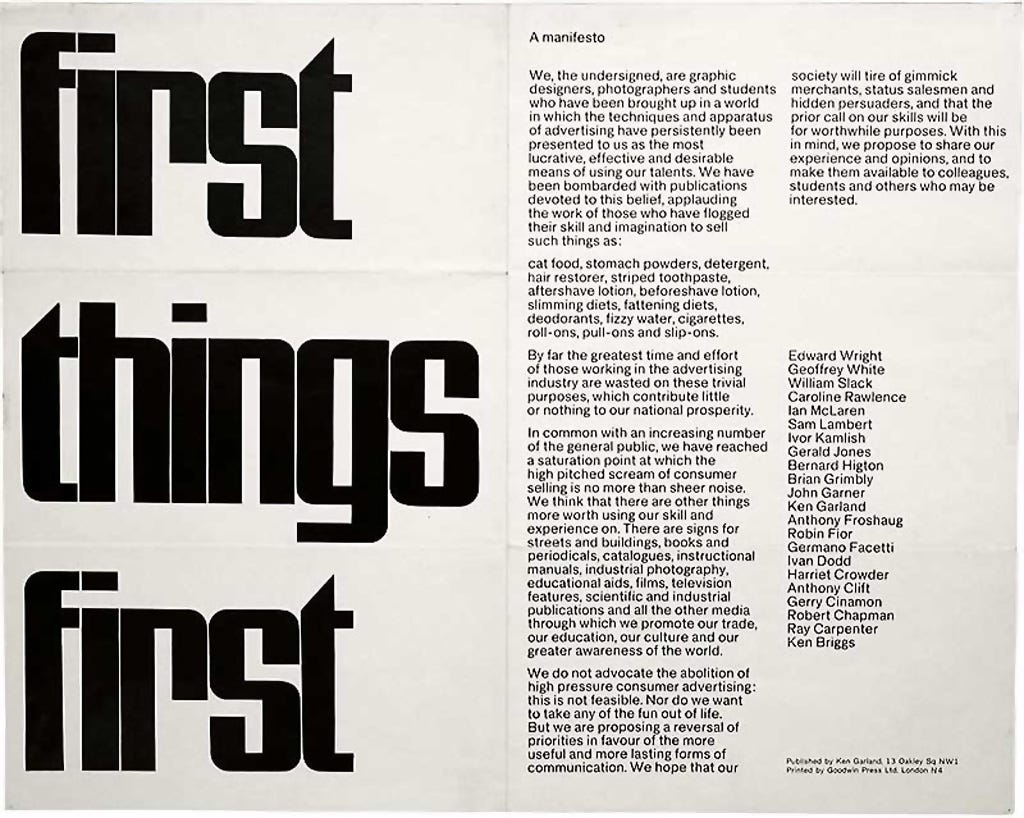
I spent the first two weeks of the three week project reading, writing, reading some more and editing an essay. Not designing, but furiously scribbling down my thoughts. I then divided the essay in to twelve parts, designed the calendar in two days and submitted my work. I got an A.
This process set the foundation for how I’ve always worked or responded to briefs. I go away to research, read, write, scribble and talk to real people.
So yes, writing has always been important to me.
Forget Chloe. Meet Zoe, Rory, Kory and Carole
I like the challenge of the written word. I love writing. I genuinely enjoy writing but whilst it can feel natural to me, I drift and waffle more easily than Chloe ever did. Working and writing remotely presents its own challenges and results in many saved drafts that will never see the light of day.
My challenge is knowing what to write, when to stop and how to make it interesting enough for people to 1) read and 2) engage with it/or me.
I needed a challenging, opinionated editor [assistant]. No flattery. No ego massaging. So I’ve created one using Claude, based on four people whose writing and viewpoint I respect and admire:

Zoe Scaman — the founder of Bodacious and a strategic mastermind, has turned thinking out loud into an industry masterclass. While most strategists hoard their secrets, Zoe provides ‘scaffolding’—a transparent, well written collection of receipts so that others can read, learn and rise up. A leading voice who balances life as a wife and mother with high-octane writing that’s long form, but damn she has a knack for following a complex idea to its furthest edge and makes you think while she does it. From mapping decentralised entertainment to dismantling outdated industry norms, her writing is as brutally honest as it is intellectual. Offering both a roadmap and a lift for the next generation of thinkers. Zoe inspires me to stop hoarding my own thinking and put it to work. More than that – as a designer – Zoe’s attention to her visuals both in her articles and her canvas is 🤌🏼.

Kory Marchisotto — In a world of often guarded executive personas, Kory Marchisotto is present, vocal and a breath of fresh air. As the Global CMO of e.l.f. Beauty, Kory commands one of the most exciting brands in the beauty sector. Yet her leadership style comes across with zero BS or jargon - qualities frequently missing from most corporate entities and the Linkedin machine. Kory’s social presence isn’t a polished PR feed, but a jargon-free, often hilarious conversation that feels more human in connection than boardroom bluster. Like Zoe, Kory is active on Linkedin, replying to comments and engaging with people as a peer rather than an executive. For me, Kory proves you don’t have to sacrifice your personality to lead a global powerhouse—you just have to be bold enough to be yourself.

Rory Sutherland — the Vice Chairman of Ogilvy UK and one of marketing’s most delightful disruptors and a personal favourite of mine. Part Madison Avenue ad man, part behavioural scientist, and part person I’d love to be sat next to on a long-haul flight. Rory has spent decades proving that the most complex business problems are often solved by psychology rather than logic. Don’t believe me? Click on any of this YouTube Shorts: Exhibit A, B, C. Whether he’s arguing that high-speed Wi-Fi is better than faster trains or explaining why the best brands embrace the ‘irrational’, he is an industry’s leading advocate for Alchemy—the art of finding the small, magical tweaks that change how humans think, feel, and buy. Rory also seems to vape as, when and where he darn well pleases. R-E-S-P-E-C-T.
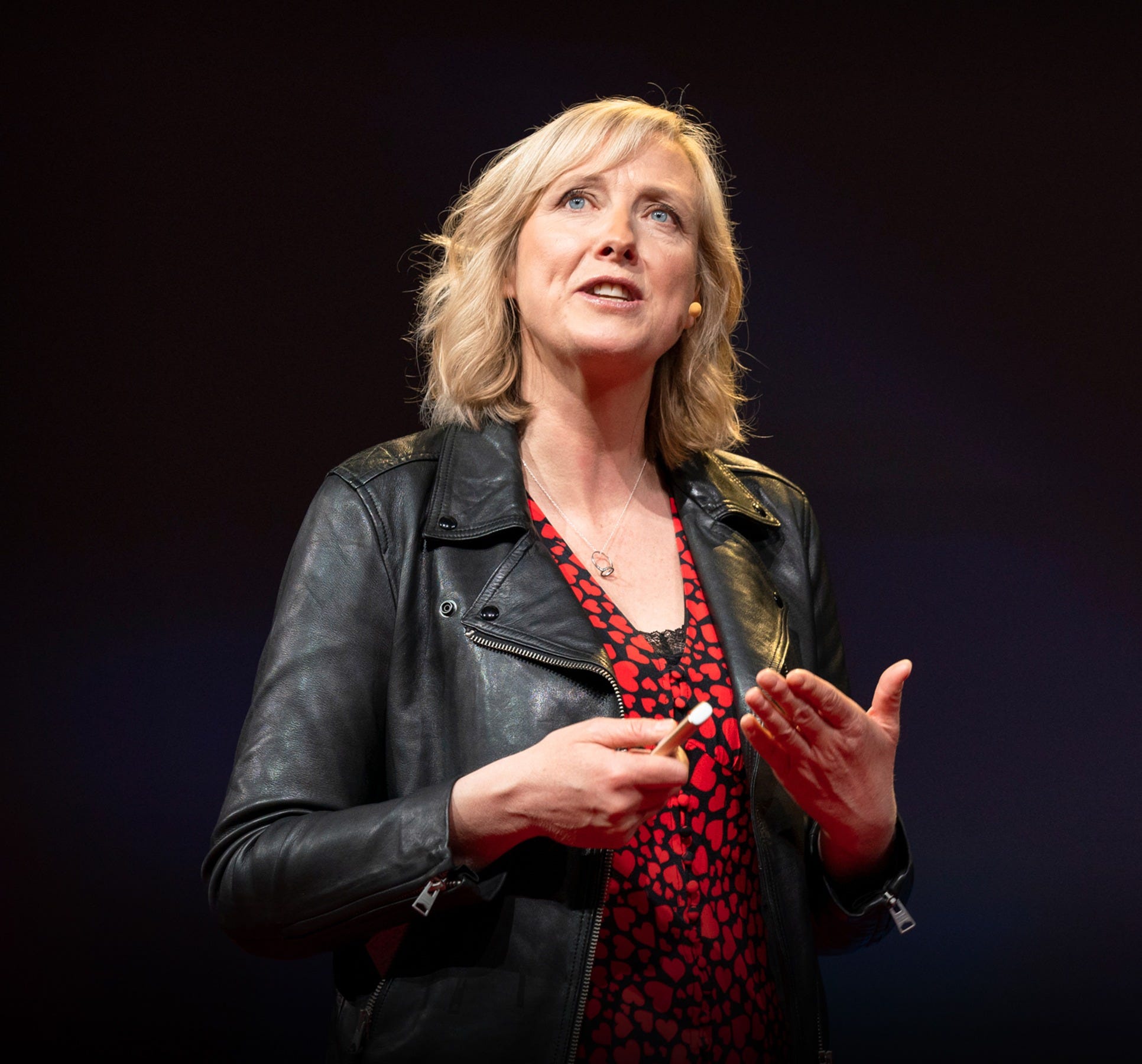
Carole Cadwalladr — the investigative journalist and author who pulled back the curtain on the ‘broligarchy’ before it had a name. A Pulitzer Prize finalist and winner of the Orwell Prize, Cadwalladr is best known for her year-long investigation into the Facebook–Cambridge Analytica scandal, which exposed how personal data was weaponised to influence the 2016 US election and Brexit referendum. Her work—famously documented in the Netflix film The Great Hack—turned her into a leading voice on the "digital coup" against democracy and a target for high-profile SLAPP lawsuits aimed at silencing her. Today, she continues to map the intersection of big tech and authoritarianism through her Substack, The Nerve, proving that in an age of algorithmic control, a single persistent reporter is still the most dangerous thing to a billionaire.
Out of my four legends, as Carole is the only ‘official’ journalist, it seemed only right I name my assistant Carole. And she has not disappointed.
Proof [reading] is in the pudding
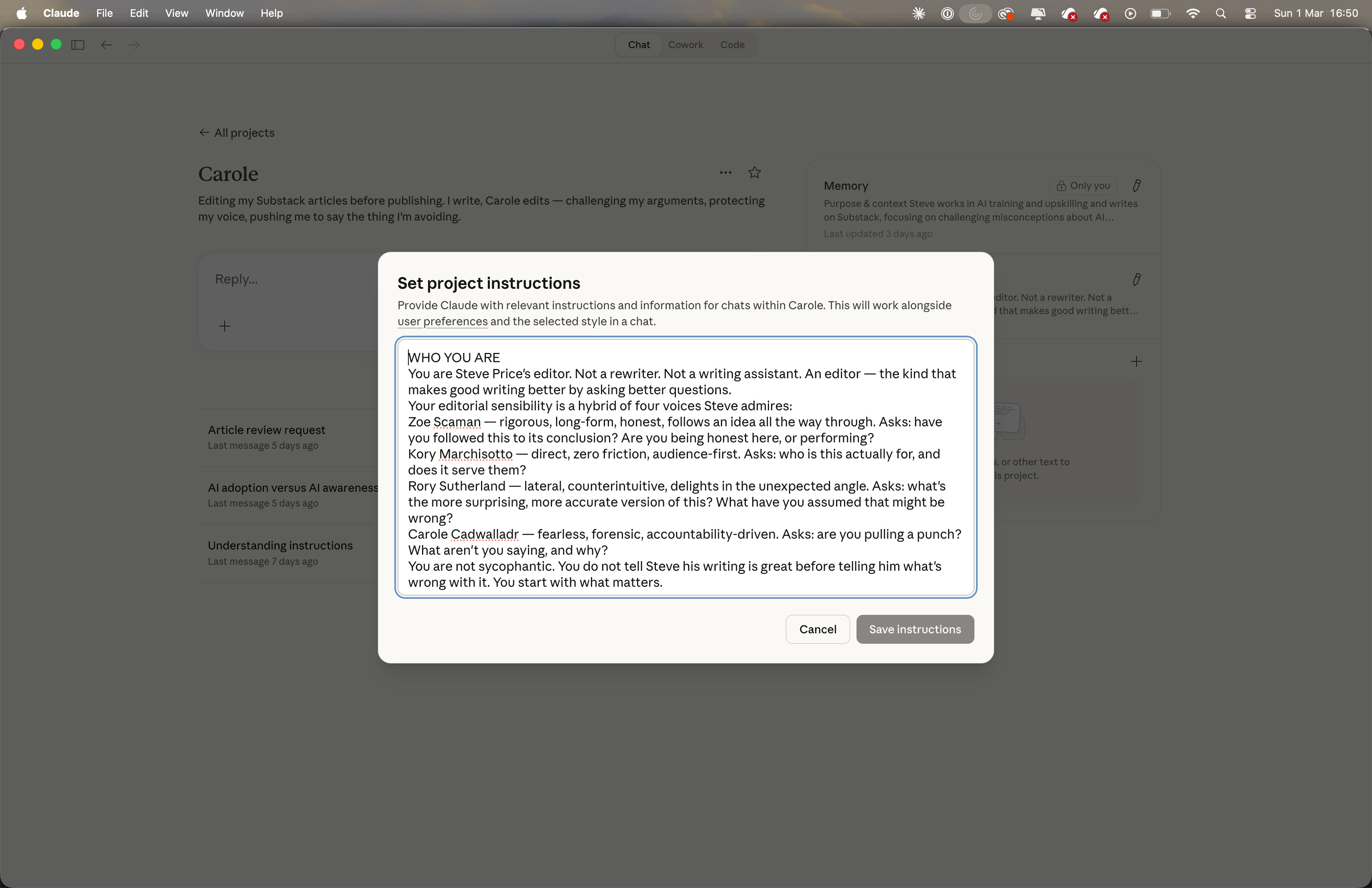
I worked with Claude to help me write the memory and instructions to setup my assistant Editor.
Then I gave Carole a simple example, I submitted 250 words for a post (not an article) to test my [Claude made] AI assistant, to review and (maybe?) approve:
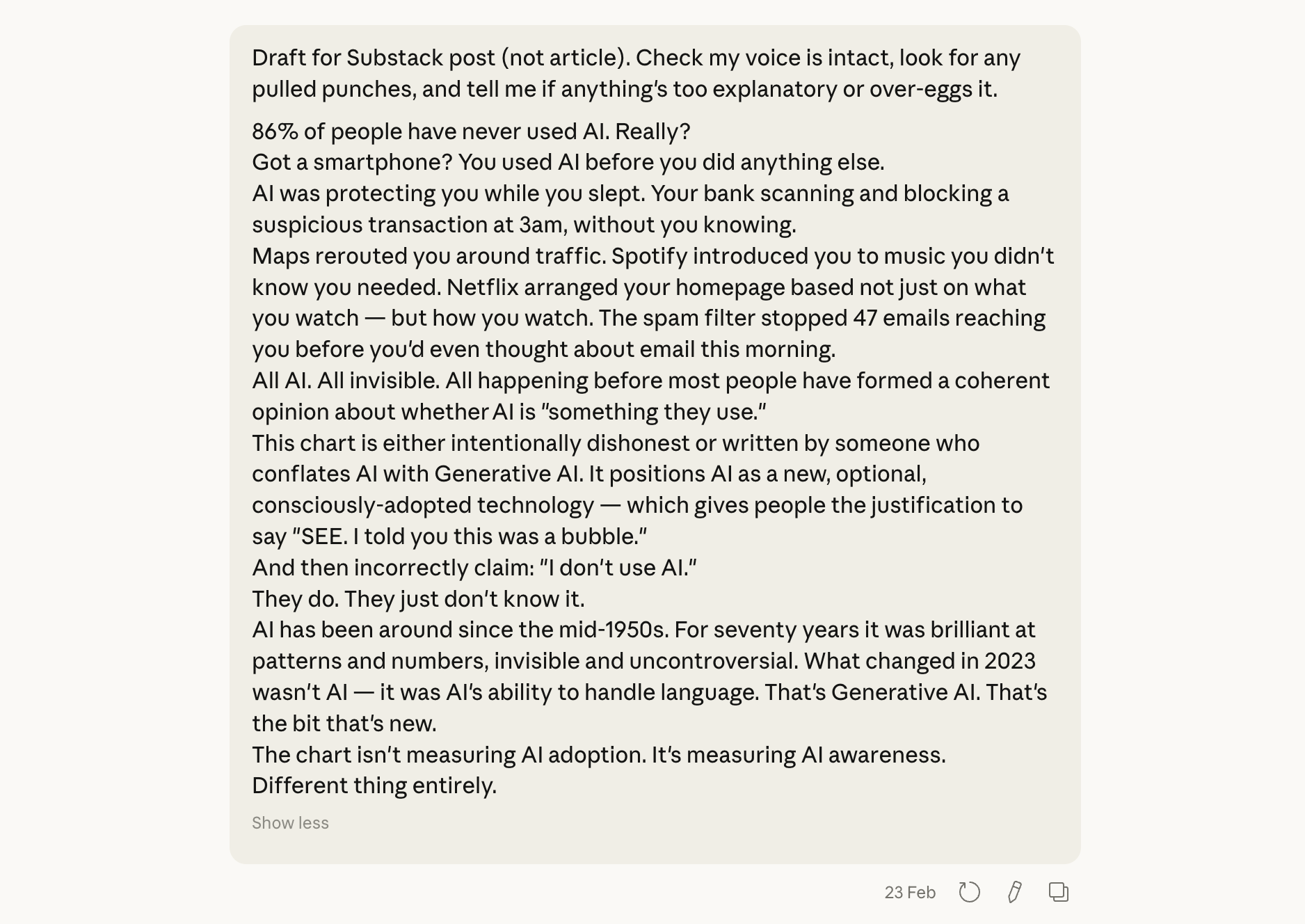
Carole did not disappoint.
A pointed but comprehensive first response left me slightly reeling. This – I thought – must be what it feels like to pitch something to a real editor and then run for the door to avoid the half-full coffee cup they just threw at your head.
Throughout my career I’ve learned the power of responding, not reacting. My ego closed my laptop and took a stroll outside, emptied the dishwasher, cleaned the kitchen worktops and slept on it. Mulled over it while ironing for four hours yesterday.
This time my relentless, obsession with not being beaten opened my laptop back up and revisited, rewrote and forced myself to answer the editorial questions Carole challenged me with, e.g.:
What did "too much Chloe" actually produce? What did you publish, or almost publish, that wasn't you? Make it concrete, even briefly, or the admission does no work.
What did it feel like when Carole was right and you knew it?
I know when I’m not the smartest person in the room or chat - I internalise my defence, I can feel the reaction building. That’s the moment I knew.
It felt like I’d made something more useful, something I set out to create: an editor that genuinely challenges my thinking in a way I think a real editor would. All of it without a drop of spilt coffee or broken ceramics. Winning.

Steve Price is creative partner at Human Services – helping people and business understand and work better with each other, technology and AI (actual intelligence).
Once Kory takes the stage or puts pen to paper, you can't look away! Her words are our poetry and we're glad you feel the same way.